
When water isn’t enough.
Cement dust, hard-water scale and baked-on droppings bond to the glass. They don’t wash off, and scrubbing harder damages the coating. We identify the contaminant and remove it with specialised chemicals and proven processes.
Two problems. Two solutions.
Every plant gets soiled. Plants near cement works, mines, quarries, roads, farms or the coast also get contaminated, and that needs a different approach.
Loose dirt that sits on the glass
Dust, sand and pollen build up steadily and reduce output. With the right water and a soft brush, they come off cleanly.
- Examples
- Dust, sand, pollen, fresh bird droppings
- Bond
- Loose, on the surface
- Removal
- Low-mineral water and brushing
- Managed by
- Sensors, schedules, robots and crews
Deposits bonded to the glass
Some deposits react with dew or rain and set like a film. They block light all year and get harder to remove over time.
- Examples
- Cement and lime dust, mineral scale, soot, oily film, lichen
- Bond
- Chemically or physically bonded
- Removal
- Specialised chemical, dwell, brush, rinse
- Managed by
- Our contaminant specialists and chemical partners
Contaminants we treat.
Each one needs its own chemistry and process. Using the wrong product can etch glass, attack frames or void a module warranty.
Cement and lime dust
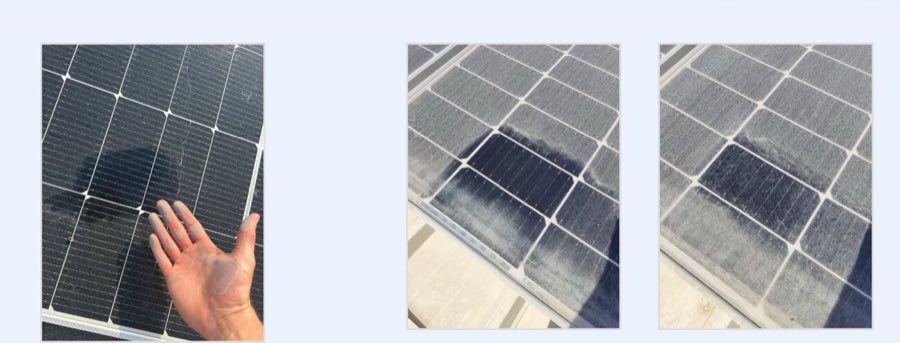
Sets in morning dew into a hard, grey film. Common near cement plants, quarries and construction.
Hard-water scale
White mineral rings left when hard or salty water dries on the glass.
Bird droppings
Baked-on deposits that shade cells and can cause hot spots.
Soot and industrial fallout
Fine carbon and particulates from industry, mines and traffic.
Oily and sticky film
Diesel exhaust, sugar-cane ash, crop spray and pollen residue.
Lichen and biofilm
Organic growth on frames and glass edges in humid and coastal sites.
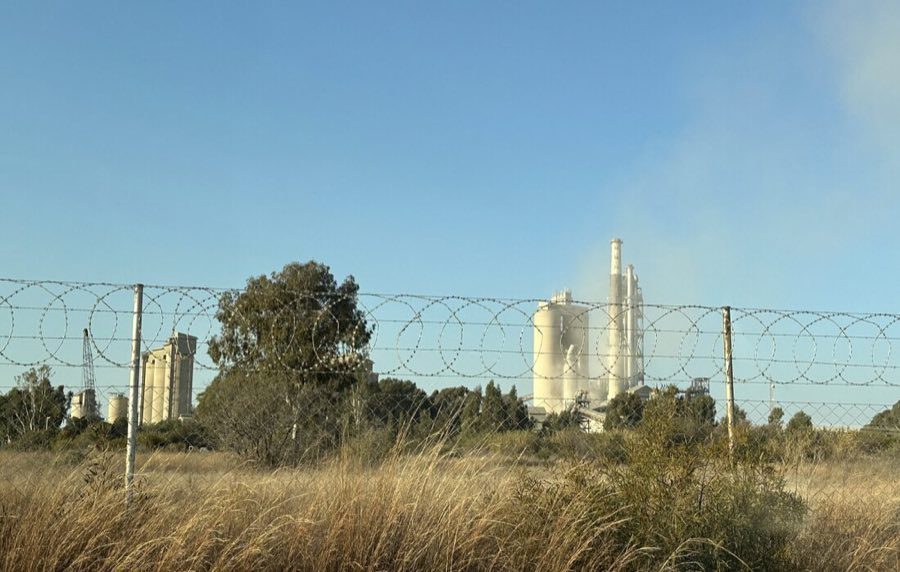
A solar plant next to a cement works.
Cement dust from a neighbouring plant had set into a film that normal washing couldn’t shift. We tested the water, identified the deposit, trialled a cement removal product on test modules and cleaned the rows with our crews, then rinsed with treated water.
- Water hardness tested before cleaning
- Product proven on a test patch first
- Applied dry, left to react, brushed and rinsed
- Soiling sensor installed to track the return of dust
Identify. Test. Treat. Rinse. Protect.
Five steps, matched to the five rows in our C. Nothing goes on your modules until it has passed a trial.
Identify
Site survey, drone images and samples show what the deposit is and where it comes from.
Test patch
Products are trialled on a few modules and checked against the module maker’s guidelines.
Treat
Applied to dry panels, left to react, then worked in with soft brushes.
Rinse
Rinsed with softened or RO water so no new scale is left behind.
Protect
Optional anti-soiling coating slows the next build-up and makes routine cleans easier.
Products from specialist chemical companies.
We partner with specialist chemical manufacturers and choose the product for the contaminant, the glass and the water on your site.
Cement removers
Dissolve set cement and lime films so they can be brushed off without abrasion.
Descalers
Lift mineral scale left by hard or salty water.
Degreasers
Break down soot, oily film and sticky organic residue.
Anti-soiling coatings
Anti-static and hydrophobic protection that keeps dust from sticking.
Will chemicals damage my modules or void the warranty?
Not when they are chosen and applied properly. We check every product and method against the module maker’s cleaning guidelines, trial it on a test patch first and rinse with low-mineral water. Where needed, we obtain written confirmation from the module manufacturer.
How do I know if my plant is contaminated or just dirty?
If output doesn’t recover after a normal wash, or you can see a film, rings or spots on the glass once it dries, you likely have contamination. Plants near cement works, mines, quarries, busy roads, farms or the coast are most at risk. A site assessment confirms it.
Is contaminant removal a once-off?
Usually it starts with a deep restoration clean. After that, the source is often still there, so we add contaminant treatment to the routine schedule at the frequency the data shows, and can apply an anti-soiling coating to slow it down.
Let us test a patch on your plant.
We’ll identify the contaminant, prove a method on a few modules and show you the before and after.